
Blog
How to Maintain an Office Chair: The Complete Guide to Castors, Gas Lift and Leather

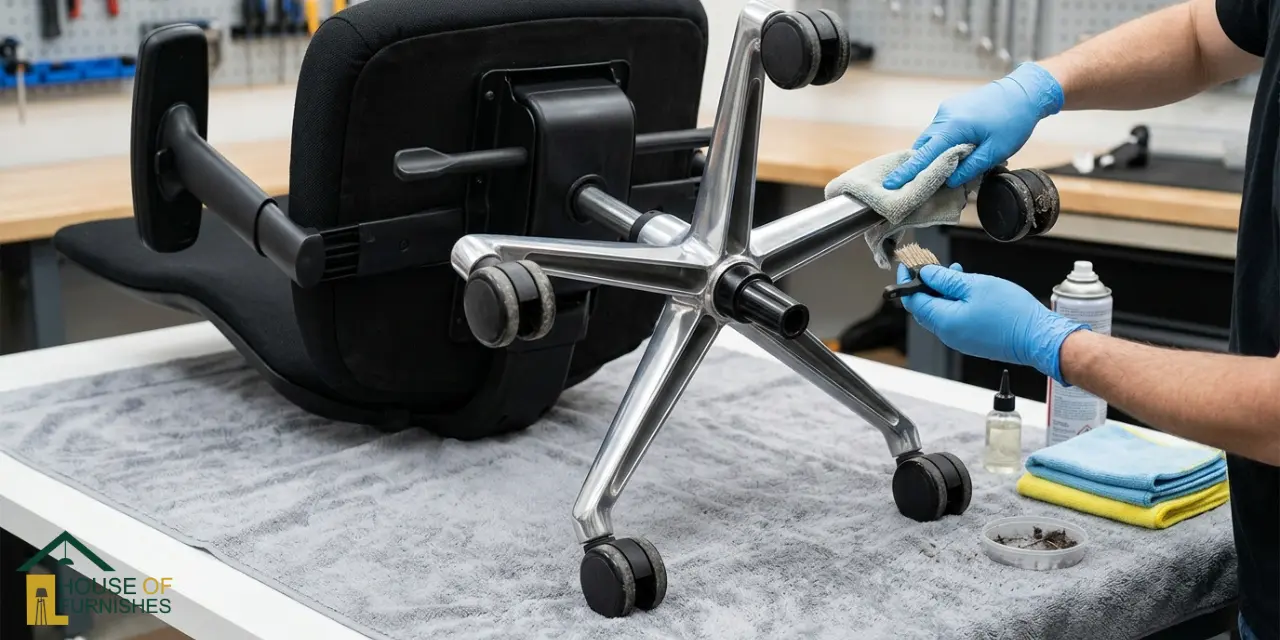
How to maintain an office chair matters more than people think — this is furniture doing 1,700+ hours a year of sitting, swivelling, rolling and leaning, and it gets less maintenance than your bike. The full routine takes fifteen minutes a quarter and genuinely doubles a quality chair’s working life. Here it is, organised by the four parts that actually fail: castors, gas lift, fixings, upholstery.
Castors: Where Every Office Chair Battle Begins
Ninety percent of “my chair rolls badly” is one thing: hair and carpet fibre wound around the axles. Every castor quietly knits itself a felt jacket; by month six it rolls like a shopping trolley.
The quarterly de-fluff (5 minutes):
- Flip the chair onto a towel
- Pull the wound hair off each wheel — tweezers reach the axle windings; a careful scissor-snip breaks stubborn wads (cut hair, never near the axle housing)
- Wipe each rolling surface — embedded grit is how mysterious floor scratches happen
- One drop of silicone lubricant per hesitant axle. Not WD-40 on carpet wheels — it attracts dust into grinding paste
While you’re down there: hard floors want soft polyurethane wheels; carpet suits harder ones. Wrong wheels wear both chair and floor — a two-minute swap fixes years of quiet damage.
The Gas Lift: The Part Everyone Mistreats
The pneumatic cylinder is robust but has two sworn enemies:
- Dropping into the chair. Every flop slams the cylinder with several times your body weight. Sit down; don’t crash-land — the single biggest predictor of a lift lasting five years or fifteen
- Sideways force. Dragging a loaded chair over thresholds bends the piston fractionally — and a fractionally bent piston is a sinking chair. Lift or push straight
The health check: set your height in the morning; if it’s lower by evening, the seal is weeping. Good news — cylinders are standardised, replaceable parts costing far less than a chair; swapping one is fifteen minutes with a rubber mallet and an online video.
How to Maintain an Office Chair’s Fixings (2 Minutes Quarterly)
- Hand-check every visible bolt — seat plate, back connection, armrest mounts. Snug, never gorilla-tight (that cracks fixing points)
- Listen for the click. A chair that clicks when you lean has a loose fixing announcing itself — clicks become wobbles, wobbles become cracks
- Aluminium base wipe: damp microfibre then dry buff — never anything abrasive on polished metal. A quality die-cast base like the one under an eames soft pad chair white will outlive every other component; help it
Upholstery: Leather, Ribbed and Mesh Want Different Love
Leather (soft pad and thin pad)
The full regime is our how to clean a leather lounge chair guide, with one office amendment: armrests and headrest first — hand and hair oils concentrate there, darkening and stiffening the hide. Plush cushions like a brown eames office chair‘s also appreciate an occasional plump-and-smooth to keep loft even.
Ribbed thin pad
The channels collect dust like tiny gutters — vacuum soft-brush along each channel (with the ribs, not across) monthly, and an eames chair brown leather stays tailored rather than tired.
Mesh
Vacuum both faces monthly; spot-clean with mild soapy water; never bleach (it weakens the weave’s tension — mesh’s entire point). Snag prevention beats snag repair: cats and velcro at distance.
The Habits That Cost Nothing
- Sit down, don’t drop — half of chair longevity in four words
- Use the whole seat — perching loads one seam and one cylinder angle all day
- Out of direct sun — UV fades leather and embrittles mesh alike
- Recline sometimes. Mechanisms that never move seize; postures that never change ache — the UK’s HSE workstation guidance makes the same point for the sitter, and it maintains the chair too. (Frames built for decades of this live at our specialist store eamesloungechairreplica.com)
FAQs
How often should an office chair be maintained?
Quarterly for the fifteen-minute full check (castors, bolts, gas lift, deep clean), monthly for the upholstery wipe, twice yearly for leather conditioning. Calendar reminders make it real.
My chair sinks slowly — is it finished?
No — the cylinder is a standard replaceable part. Measure the class, order a match, swap with a mallet and ten minutes of patience. The rest of a quality chair has decades left.
Squeaks: where do I start?
In order of likelihood: loose bolt (tighten), dry castor axle (silicone drop), dry recline pivot (silicone spray), seat-plate contact point (same). Squeaks are always metal asking for tightness or lubrication — five minutes finds which.
Final Thoughts
How to maintain an office chair in one line: fifteen minutes a quarter, a monthly wipe, and the discipline to sit rather than crash-land — that’s a chair serving comfortably for fifteen-plus years instead of wobbling out at five. Quality frames deserve the routine most: die-cast aluminium and real leather are lifetime materials waiting for an owner who treats them that way. If yours is past saving, the ones worth this care live in our Eames office chair collection — seventy years of engineering that responds beautifully to fifteen minutes of attention.