
Blog
Ergonomic Home Office Setup: The Complete Easy Guide

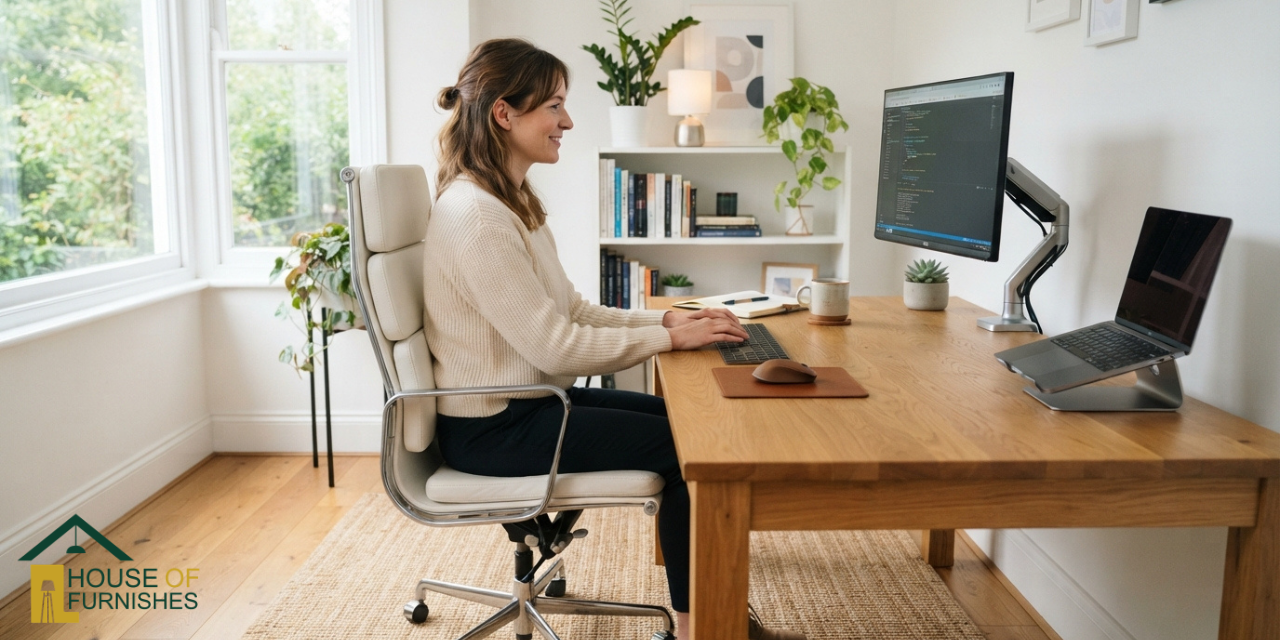
An ergonomic home office setup comes down to four numbers: elbows at 90°, eyes level with the top of your screen, feet flat on the floor, screen an arm’s length away. Get those right and you’ve solved 80% of desk aches before buying a single gadget. This guide walks the whole setup in order — chair first, because everything else is measured from where you sit.
Step 1 of Your Ergonomic Home Office Setup: The Chair
Your chair sets your body’s height, which sets everything else. In this exact order:
- Seat height: feet flat, knees ~90°, thighs parallel or knees a touch below hips — typically 42–50cm
- Hip position: sit all the way back — a backrest can’t help a hovering spine
- Back support: the chair should meet your lower back’s curve. Well-shaped backs and tensioned suspension do this by design; if yours doesn’t, a small cushion at belt height fixes it for pennies
- The recline test: the chair should give slightly to a 100–110° lean — the angle research keeps finding kindest to spinal discs. Bolt-upright 90° all day is a Victorian schoolroom myth
Back height matters more than people think. Past six hours a day, a high back catching shoulder blades and head genuinely reduces neck fatigue — the height trade-offs are mapped in our ea117 vs ea119 vs ea219 comparison. A high-back suspension design like the eames mesh chair white flexes with every posture change — moving support beats static support — while a plush build like the eames soft pad office chair black delivers the same geometry with loft; the leather-vs-weave call is a climate decision, per our leather vs mesh office chair guide. (Further frame variations live at our specialist store eamesloungechairreplica.com.)
Step 2: The Desk (Measured From Your Elbows)
- Height: shoulders relaxed, elbows 90°, forearms level with the surface. Standard UK desks (72–75cm) suit ~5’8″–6’0″; shorter people raise the chair and add a footrest, taller people add desk risers — cheaper than physiotherapy
- Depth: 60cm minimum — screen at arm’s length, keyboard 10–15cm in from the edge, room to rest wrists between typing bursts
- Under-desk zone: clear it — boxes force twisted legs for hours
Step 3: The Screen (Where Necks Are Saved)
- Height: top of screen at or slightly below eye level — books under a monitor work exactly as well as a £60 stand
- Distance: a straight arm’s length (50–75cm)
- Laptop users: a laptop’s screen and keyboard cannot both be right — physics forbids it. Stand + separate keyboard and mouse: the highest-value ergonomic purchase in existence at ~£40
- Dual screens: main screen dead centre, second angled beside — not one per shoulder with your neck as the hinge
Step 4: Light, Movement, and the Rules Nobody Keeps
- Light across, not behind or ahead — side-on daylight plus a desk lamp for dark afternoons
- 20-20-20: every 20 minutes, look 20 feet away for 20 seconds — the cheapest eye-strain fix measured
- Stand hourly. The best posture is the next posture — the NHS sitting guidance makes the same point: even a perfect setup harms in six motionless hours. Kettle trips count as ergonomics
- Camera bonus: the eye-level rule also fixes video-call framing — ergonomics and vanity, aligned at last
The 60-Second Ergonomic Home Office Setup Self-Check
- Feet flat? ✔
- Knees ~90°, hips level or slightly higher? ✔
- Back touching the backrest? ✔
- Elbows ~90°, shoulders loose? ✔
- Screen top at eye level, arm’s length away? ✔
Five ticks and your setup beats most offices. Anything unticked, fix in order — each depends on the one before.
FAQs
Do I need lumbar adjustment levers?
You need lumbar support, however achieved — well-shaped backs and tensioned suspension provide it by design. The shaped high back on an ivory white eames chair supports the spine’s curve through geometry, not knobs.
Ideal desk height for my height?
Rule of thumb: height in cm × 0.43 ≈ desk height. But the elbow test beats every formula — 90° elbows with relaxed shoulders is correct at any height.
Is a kitchen chair at a desk really that bad?
For an hour, no. For a working week, yes — fixed height, no curve, no give. Your body compensates in small ways that compound into the Friday ache.
Next Steps
Run the check, fix the cheapest gaps first (books under the monitor, keyboard for the laptop), and make the chair your one considered purchase — it touches your body 1,700 hours a year. If yours is due an upgrade, our Eames office chair collection pairs seventy years of suspension engineering with every finish this ergonomic home office setup guide mentioned. Your Friday-evening back will notice by week one.