
Blog
Barcelona Chair History: The Stunning Story of the Throne Built for a King

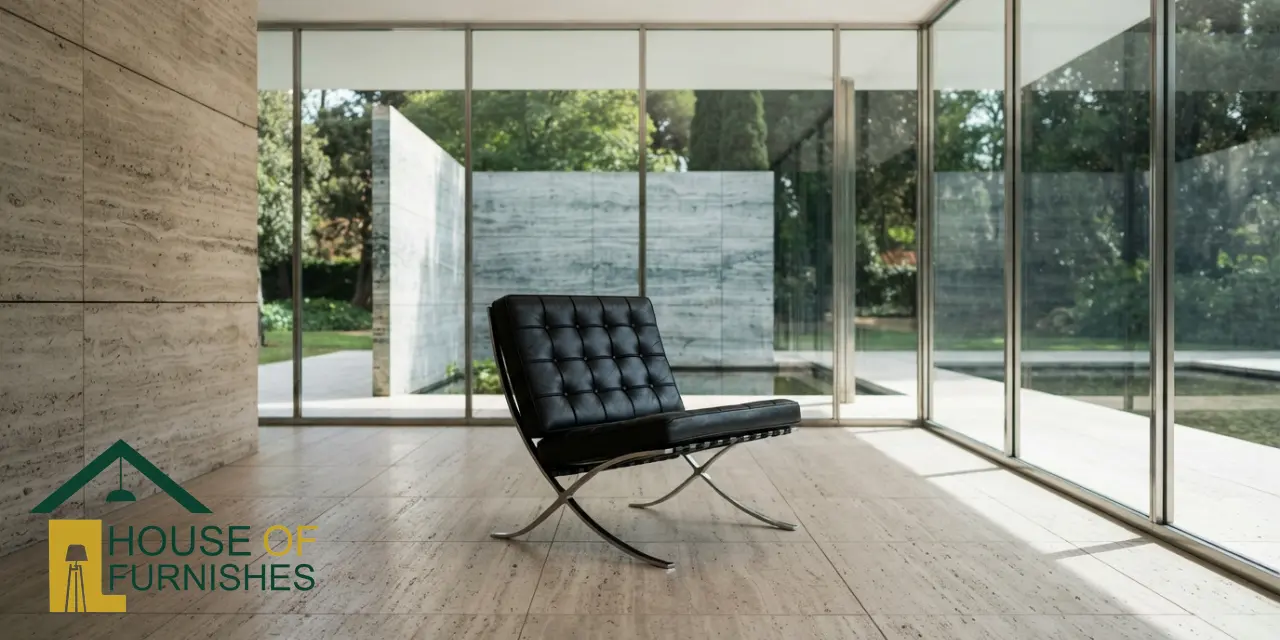
The Barcelona chair history begins in 1929, when Ludwig Mies van der Rohe designed a modern throne — quite literally, so the King and Queen of Spain would have somewhere worthy to sit. Nearly a century later, that royal brief still explains everything: why the chair is wider than it needs to be, why the frame gleams like jewellery, and why it never looks casual. Here’s the full story.
1929: A Pavilion, a King, and a Problem
Germany needed a statement. For the 1929 International Exposition in Barcelona, Mies van der Rohe — soon the last director of the Bauhaus — designed the German national pavilion: floating marble planes, glass walls, chrome columns. The Barcelona Pavilion became one of the most influential buildings of the century (rebuilt in 1986 — you can visit it today).
Then the problem: King Alfonso XIII and Queen Victoria Eugenia would open the pavilion, royalty needs seating, and no chair on earth matched the building. So Mies, working with designer Lilly Reich (whose role history under-credited for decades), designed one. His brief to himself: “monumental… an important chair, a very elegant chair” — fit for a king, in a building fit for the future.
The Design: Ancient Idea, Machine-Age Body
Here’s the detail most tellings of the Barcelona chair history miss: it’s ancient. The famous X-frame is borrowed from the curule chair — the folding X-stool Roman magistrates and pharaohs sat on as a symbol of authority. Mies took a 2,000-year-old power symbol and rebuilt it in chrome and leather:
- A single sweeping X of steel — front leg and back support as one continuous curve, brutally difficult to manufacture in 1929
- No armrests — nothing interrupts the profile
- 40 hand-cut leather panels, welted and tufted into each cushion
- Throne proportions — wider and deeper than practical, because status was the point
Historical footnote: the King and Queen apparently never actually sat in them. The most famous royal seat in design may never have held royalty.
Barcelona Chair History: From Pavilion Piece to Immortality
- 1929 — Debuts at the Barcelona Exposition
- 1930s — Mies brings the design to America, fleeing Nazi Germany
- 1948 — Production formalised; seamless stainless steel refinement
- 1950s–60s — The chair of corporate lobbies, embassies, architect studios
- 1968 — MoMA adds it to the permanent collection
- Today — Still in production, still shorthand for “serious modern interior”
Where the Eames Lounge Chair (story told in our history of the eames lounge chair) was built for cosy domestic napping, the Barcelona was built to impress while you wait. The two never competed — one says relax, the other says you’ve arrived.
Why It Still Works a Century Later
It photographs like architecture
Pure geometry, honest materials, zero decoration — correct from every angle, which is why film sets adore it.
It flatters a room without filling it
No arms, no skirt, a slim polished frame — light passes straight through. A black barcelona chair against a pale wall remains the fastest shortcut to a “designed” interior we know.
Colour rewrites its personality
A white barcelona chair reads gallery-fresh; a tan brown barcelona chair warms the chrome into something almost vintage. Same throne, different kingdoms — and UK buyers can order every colour with local delivery via houseoffurnishes.co.uk.
FAQs
Who designed the Barcelona chair?
Ludwig Mies van der Rohe with Lilly Reich, in 1929, for the German Pavilion at the Barcelona International Exposition — hence the name.
Was it really made for royalty?
Yes — created for the King and Queen of Spain to use at the pavilion’s opening, which is why it carries throne-like proportions.
Why is the Barcelona chair so expensive?
Licensed originals hand-cut and hand-welt 40 leather panels per cushion set over a seamless polished frame. Quality replicas use the same construction logic at a fraction of the price — which is why the design fills so many UK homes.
Final Thoughts
The Barcelona chair history is a lovely irony: a chair built for one afternoon of royal ceremony became permanent furniture for the modern world. If your living room could use that quiet authority, browse our full Barcelona chair collection — six leather colours, same 1929 geometry, no coronation required.